


Free written scope consultation - allowances, timeline, and change-order rules on paper before a single trade is scheduled
Quikrete Home Additions & ADU: The San Diego Owner’s Guide
Quikrete concrete products show up differently in home additions and ADU construction than they do in a weekend fence-post project. When we frame an addition in San Diego, Quikrete typically appears as the structural base, concrete mix for footings, or surface material for floors and patios tied to the new square footage. A full home addition or ADU build in San Diego runs $53,100 to $153,400, though we’ll break down below what drives that number up or down.
The conversation usually starts when a homeowner notices something wrong with an existing Quikrete surface or sub-surface. Cracks spidering across a slab, a footing that’s settled and left a gap under the sill plate, moisture wicking up through a Quikrete pad that was poured without a vapor barrier in the first place. San Diego’s coastal air and clay-heavy soils in neighborhoods like Clairemont and Normal Heights do specific things to concrete, and we’ve spent years reading those failure patterns. Penhallow Remodeling San Diego is an independent general contractor, not affiliated with Quikrete. We work with their products because they’re predictable when installed correctly.
Trevor Nash will tell you the same thing at a walkthrough. Concrete fails for knowable reasons. Our job is figuring out which reason applies to your job, then putting a written number in front of you before anyone touches a wheelbarrow.
Key Takeaways
- Full home additions in San Diego typically run $53,100 – $153,400; ADUs run $106,200 – $259,600 depending on foundation work, site access, and finish level.
- Quikrete products on addition sites are usually footing mix, slab mix, or surface toppings; the failure point is rarely the product itself.
- We put a written price and a written 365-Day Done Right Promise on every job, before the first bag is opened.
- Call (619) 604-9624 for a free estimate. A live person answers 24/7.
Which Quikrete Products Show Up on Home Additions & ADU Projects
Quikrete makes hundreds of SKUs, but on a San Diego addition or ADU site, you’re almost always dealing with one of four product families. First, Quikrete 5000 Concrete Mix (5000 PSI) is the workhorse for footings and structural slabs. Second, Quikrete Crack-Resistant Concrete Mix gets specified when we’re pouring interior slabs that will receive tile or flooring. Third, Quikrete Sand/Topping Mix handles thin pours like a leveling cap over an existing slab or a shower pan in a converted garage ADU. Fourth, Quikrete Concrete Resurfacer comes into play when the existing slab is sound but cosmetically shot.
Here’s the compatibility gotcha most homeowners don’t know: not all Quikrete mixes are rated for the same pour depth. Quikrete 5000 wants a minimum 2″ pour for structural work; any thinner and it won’t cure to spec. Topping mixes are the opposite: they’re designed for feathering down to 1/2″ or less. We’ve seen well-meaning homeowners pour a footing with sand/topping mix because the bag was cheaper, and the result was a footing that crumbled under load. If you’re matching an existing failed pour, check the old material before you buy the replacement.
On the OEM-versus-aftermarket question: for Quikrete bagged products, there is no meaningful aftermarket. The product is the product. The variable that matters is water ratio, cure time, and substrate prep, which is why we’re specific about mixing and curing on every job. A good bag of Quikrete poured on uncompacted soil is a liability. A good bag poured with proper compaction, rebar where needed, and a 28-day cure is a foundation you won’t think about again.
Styles & brands we work with







Signs Your Quikrete Home Addition or ADU Surface Is Failing
- Hairline cracks that widen each season. San Diego’s hot-dry summers and moist coastal winters cause concrete to expand and contract. A crack that opens past 1/8″ usually means the slab wasn’t reinforced or the subgrade settled unevenly.
- Moisture darkening along slab edges. This is a vapor barrier failure. Water is wicking up from the soil through the Quikrete slab, which will eventually damage flooring adhesives and base moulding.
- Spalling or flaking on the surface. This is freeze-thaw or alkali-silica reaction damage. Freeze-thaw is less common in San Diego proper, but it shows up in East County where winter nights dip below 40°. It almost always traces back to over-wet concrete at pour time.
- A visible gap between the foundation and the sill plate. The footing has settled. In San Diego’s expansive clay soils, particularly in Mission Valley and parts of Chula Vista, this is the most expensive failure because it gets into framing and drywall if ignored.
- Chalky white residue (efflorescence) on the surface. Water is moving through the slab and carrying minerals to the surface. It’s a sign of ongoing moisture transmission, not just a cosmetic stain.
See the difference
 Before
 After
After Before
 After
After Before
 After
AfterReplacement Cost & What’s Included

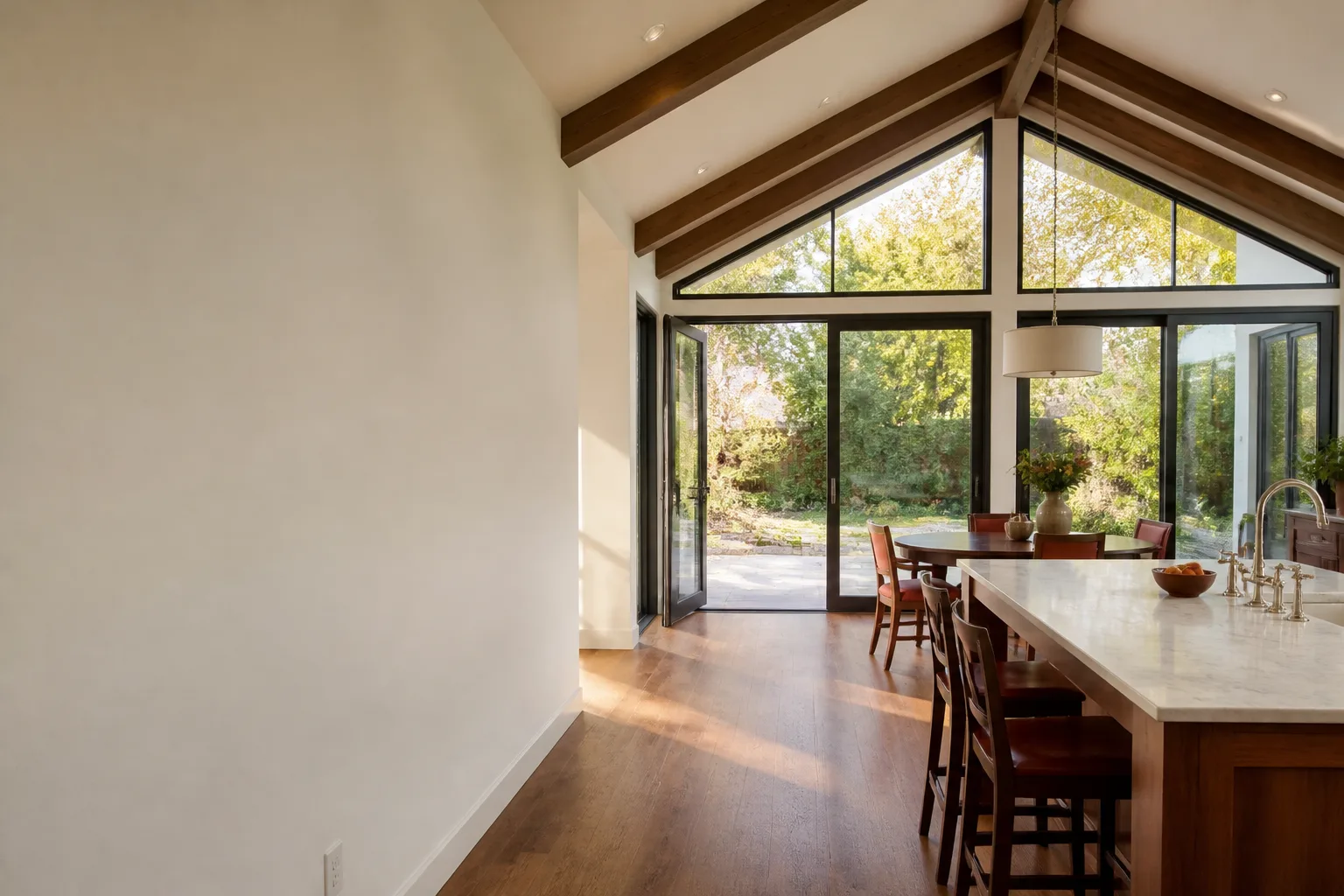
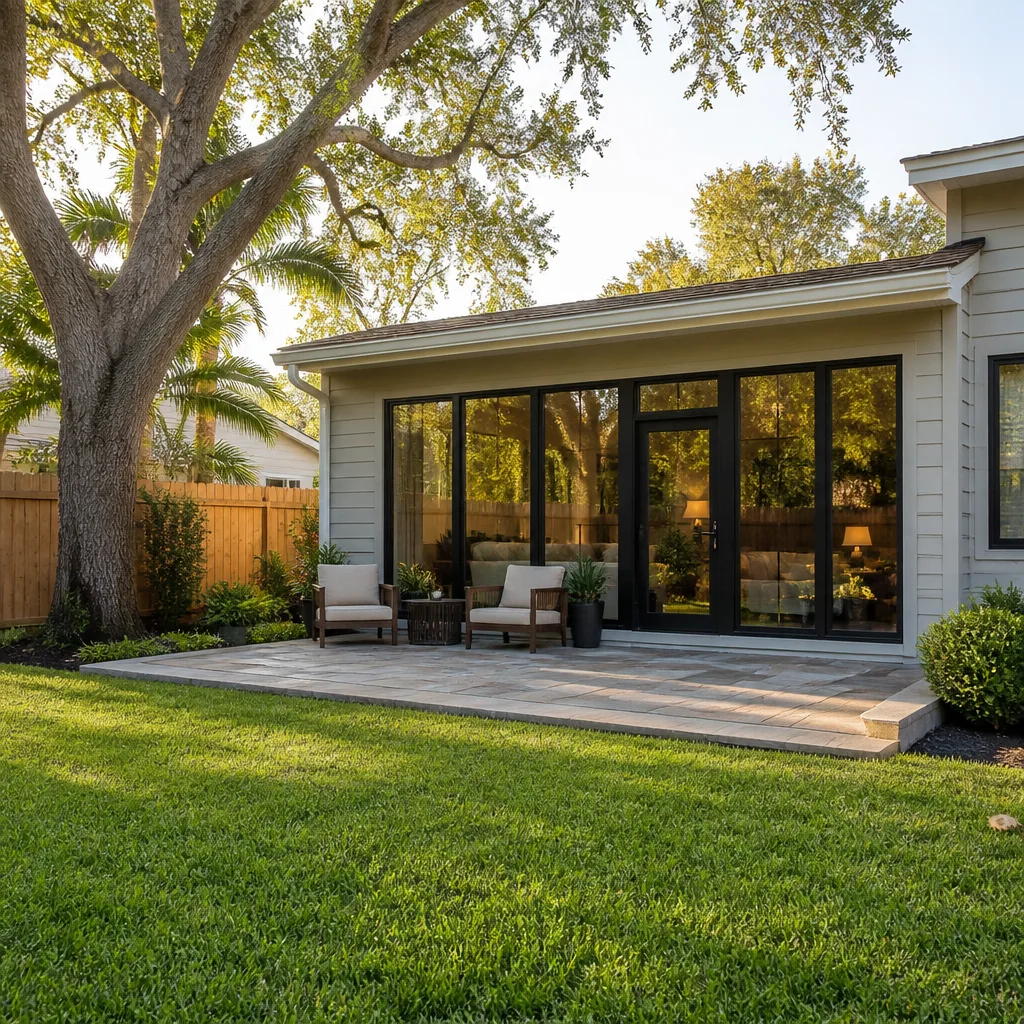
The $53,100 – $153,400 range for a home addition in San Diego covers everything from a compact bump-out to a full primary-suite addition. ADU construction runs higher, $106,200 – $259,600, because you’re adding a kitchen, bath, and often a separate meter. Where Quikrete fits into that number depends on what we’re doing: a single concrete pad replacement inside an existing addition might run $5,310 – $14,160 as part of a larger scope, while a full foundation pour for a new ADU is a line item inside the six-figure total.
What drives the number up: expansive clay soils that require deeper footings and more compaction work, site access that’s too tight for a concrete truck (meaning hand-mixing on site), and any existing damage that’s migrated into framing. What drives it down: a clean, level site with good access and an existing pad that can be resurfaced rather than removed.
Every quote we write includes three things. A written price before work starts, with the line items broken out so you can see exactly what you’re paying for. A written 365-Day Done Right Promise: if our concrete work fails inside a year, we come back and fix it at no charge. And a free second visit if something goes wrong, no service call fee, no re-inspection charge. Trevor’s been on the other side of a contractor who disappears after the check clears. He built this company so that doesn’t happen.
DIY or Call Us?
Mixing and pouring Quikrete looks simple on the bag. What the bag doesn’t tell you: the subgrade has to be compacted to 90% or better, the form work has to be squared and braced, and curing is a 28-day chemical process, not a “dry overnight” process. A homeowner with gloved hands and a wheelbarrow can absolutely pour a small landing or patio pad. What we’d steer you away from: anything structural, any pour over 2″ thick, any slab that will carry wall load, and any repair where the existing concrete is spalling so badly you can’t tell what’s underneath.
If the slab you’re looking at supports walls, holds up a roof, or sits under a kitchen you cook in daily, call us. (619) 604-9624. Trevor will walk the site, tell you what’s actually wrong, and put a written number in front of you before you commit to anything. Tell me what you need, I’ll tell you what it costs, and we’ll go from there.
FAQs
A properly mixed, poured, and cured Quikrete slab in San Diego will typically last 30 to 50 years before showing structural cracks, though surface wear shows sooner in high-traffic areas. The lifespan depends more on subgrade prep and moisture control than on the Quikrete mix itself. Call (619) 604-9624 if you’re seeing cracks and want an honest read on whether they’re cosmetic or structural.
Yes, if the crack is under 1/8″ wide and the slab isn’t settling, we can often repair it with a Quikrete-compatible patching compound and resurfacer. If the crack is wider or one side of the slab has dropped, the failure is usually in the subgrade and the section needs to be cut out and re-poured. Call (619) 604-9624 for a free assessment.
The pour itself usually takes one day, but the full process including demo, subgrade prep, form work, pour, finishing, and cure time before framing can span 5 to 10 days depending on site access and weather. We don’t rush cure time, because concrete that’s walked on too early never reaches its rated strength.
We stock common Quikrete mixes, resurfacer, and patching compounds on our trucks, and we source specialty products from local San Diego suppliers the same day when a job needs something specific. Penhallow Remodeling San Diego is independent from Quikrete, which means we’re not locked into any one product line. We also work with materials from KraftMaid, Cambria, and Silestone on interior finishing work, so the whole addition comes together under one roof.
Written by Trevor Nash, Owner, Penhallow Remodeling San Diego at Penhallow Remodeling San Diego, serving San Diego and nearby areas.


