
Free written scope consultation - allowances, timeline, and change-order rules on paper before a single trade is scheduled
Cambridge Pavers Home Additions & ADU: The San Diego Owner’s Guide
If you’re planning a home addition or ADU in San Diego and want Cambridge Pavers as the hardscape surface, a full project typically runs $53,100 to $153,400 depending on square footage, site prep, and paver style. Penhallow Remodeling San Diego installs Cambridge Pavers-compatible additions and ADUs, and we carry the full range of Cambridge paver lines including their structural and permeable options. Most homeowners reach out to us after realizing their existing paver areas are failing or after a previous contractor left them with uneven surfaces, poor drainage, or pavers that shifted within the first year.
We’re an independent San Diego remodeler, not a Cambridge Pavers affiliate. That matters because we’re free to tell you exactly what works and what doesn’t, based on two decades of running crews across this city’s soil conditions.
Which Cambridge Pavers Models This Applies To

Cambridge Pavers ships several product lines that behave differently in San Diego’s dry, compacted soil. The Ledgestone and Rounding Stone lines are popular for patio and walkway surfaces. For driveways and ADU approaches, the thicker Holland Stone and Brickstone lines hold up better under vehicle weight. The key compatibility gotcha: Cambridge wall units and paver units are not interchangeable. A Ledgestone wall block won’t lay flat as a paver, and a paver won’t sit correctly as a retaining wall cap without cutting.
Identifying your existing paver is easier than most people expect. Flip over a loose paver and look for the Cambridge stamp or a molded lot number. If it’s worn off, measure the paver thickness. Cambridge pavers run 60mm thick for pedestrian areas and 80mm for vehicular applications. If you’ve got 60mm pavers in a driveway, that’s your failure point right there. We stock both thicknesses on our trucks for San Diego jobs.
For OEM versus aftermarket: Cambridge still manufactures most current lines, so matching is straightforward if we can identify the series. If the line is discontinued, we work with local San Diego stone yards that carry equivalent color blends and dimensions. We always tell homeowners which they’re getting and why before any order is placed.
Styles & brands we work with







Signs Your Cambridge Pavers Home Additions & ADU Is Failing
- Sunken paver sections near the home addition foundation. This usually means the base layer wasn’t compacted properly before the pavers went down. San Diego’s clay-heavy soil expands and contracts, and a thin base will shift within two seasons.
- Pavers that rock or wobble underfoot. Loose bedding sand has washed out from underneath. This happens most often on sloped lots in areas like Mission Hills or Point Loma, where rainfall runs hard across paver surfaces.
- Gaps opening up between pavers along the ADU walkway. Edge restraints were either missing or installed below grade. Without a solid edge, pavers drift outward and the whole surface loses its interlock.
- White residue or efflorescence bleeding across paver faces. Water is moving through the pavers and pulling minerals to the surface. It’s cosmetic, but it signals a drainage issue underneath that will get worse.
- Low spots that hold water after rain. The grade wasn’t pitched correctly. In San Diego, where we get short intense rain bursts, standing water on pavers accelerates erosion and algae growth on shaded surfaces.
Replacement Cost & What’s Included
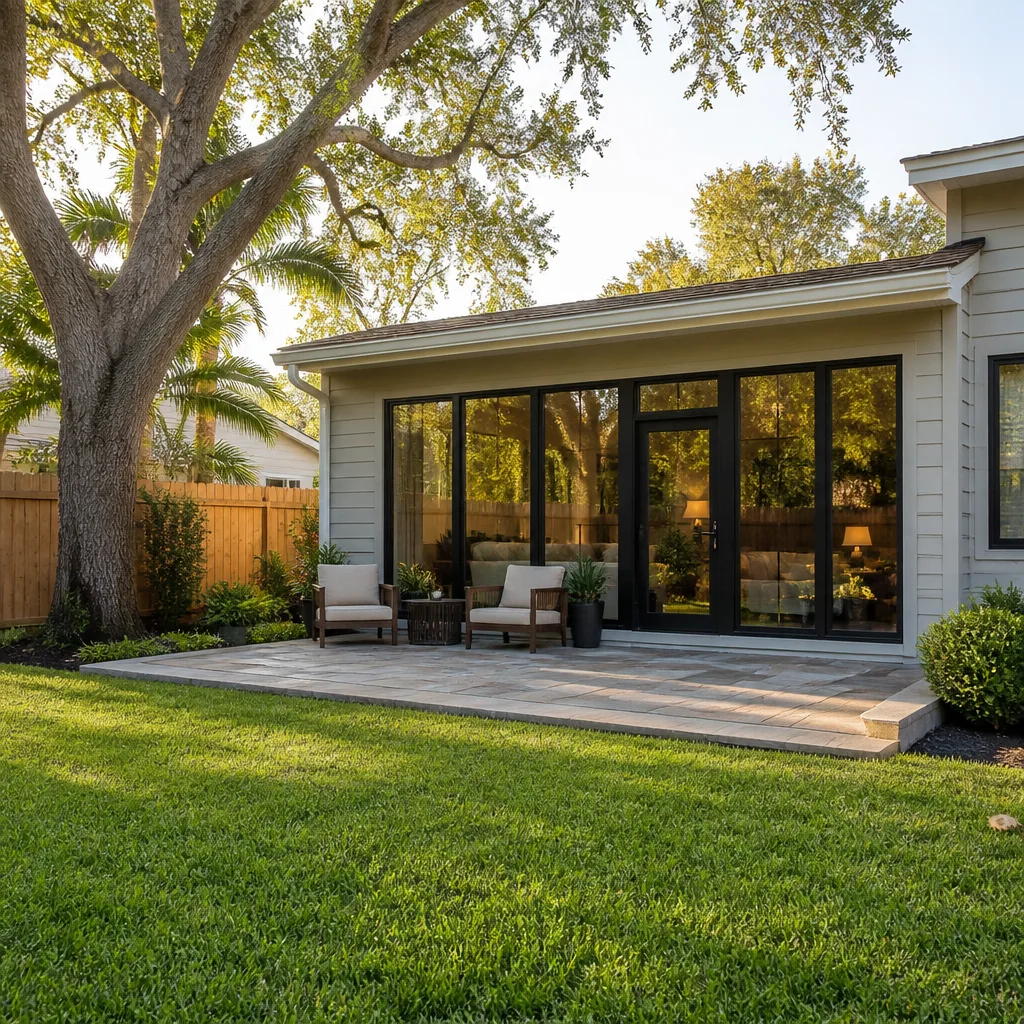
For a home addition or ADU paver project in San Diego, figure on $12 to $28 per square foot installed, which lands most full projects between $53,100 and $153,400. A simple patio area might run toward the lower end. A project that includes demolition of existing failed pavers, regrading, new base material, and border restraints will push toward the top of that range.
Here’s what we include on every Cambridge Pavers project:
- Demolition and haul-off of failed paver surfaces and old base material
- Excavation to proper depth (usually 7 to 9 inches total for a driveway-grade surface in San Diego)
- Class II road base compacted in lifts, not just dumped and raked
- Polymeric sand swept between joints to lock pavers and resist weed growth
- Aluminum or concrete edge restraints pinned in place
- Written line-item price before we start and a written 365-Day Done Right Promise on the whole job
The price on day one is the price on the invoice. No change orders, no “we discovered a problem” add-on fees. We explain the substrate (the compacted layer beneath your pavers) before we dig, so you understand exactly what you’re paying for.
See the difference
 Before
 After
After Before
 After
After Before
 After
AfterDIY or Call Us?
You can safely check a few things yourself. Pull up a loose paver and look at the base underneath. If the base is thinner than your thumb, that’s your problem. If you see tree roots or ants, that’s coming from below and it won’t fix itself. What you should not do is pull up large sections and try to relay them. Paver work looks simple and isn’t. Without proper compaction and edge restraint, you’ll be back in the same spot in eighteen months, and you’ll have spent the money twice.
For a home addition or ADU, the paver work ties directly into your foundation drainage and grading. A mistake there means water running toward your new structure instead of away from it. That’s not a weekend fix. Call (619) 604-9624 and we’ll take a look. Trevor Nash has been running crews in San Diego long enough to spot a bad base job before he unloads a single tool.
Key Takeaways
- Cambridge Pavers home addition and ADU projects in San Diego run $53,100 to $153,400 installed
- Paver thickness matters: 60mm for pedestrian areas, 80mm for driveways and vehicle surfaces
- Most paver failures trace back to the base layer, not the pavers themselves
- We stock Cambridge lines on our trucks and source discontinued colors locally
- Every job gets a written price and a written 365-Day Done Right Promise
FAQs
Cambridge Pavers typically last 30 to 40 years in San Diego’s climate when installed over a properly compacted base. The pavers themselves rarely fail. What fails is the base underneath, which is why we spend more time on excavation and compaction than on laying the surface. Call (619) 604-9624 if you want us to inspect your existing base before pavers go down.
Yes, if the failure is localized. A sunken section can be lifted, the base recompacted, and the pavers relayed. If the base has failed across a wide area, repair stops making sense and full replacement is the honest recommendation. We’ll tell you which one you need after we pull up a section and look underneath.
Most San Diego paver projects for additions and ADUs run 5 to 10 working days from demolition to final polymeric sand application, depending on square footage and access. Larger projects with retaining walls or drainage work push toward the longer end. We’ll give you a written timeline with your written price.
We stock the most common Cambridge lines on our trucks, including Ledgestone, Holland Stone, and Brickstone in both 60mm and 80mm thicknesses. For less common colors or discontinued series, we source from San Diego stone yards that maintain Cambridge inventory. We also work with KraftMaid, Cambria, and Silestone materials on the interior side of ADU projects.
Tell me what you need, I’ll tell you what it costs, and we’ll go from there. Call (619) 604-9624 to schedule a free estimate on your Cambridge Pavers home addition or ADU project. A live person answers, every time.
Written by Trevor Nash, Owner, Penhallow Remodeling San Diego at Penhallow Remodeling San Diego, serving San Diego and nearby areas.


