
Free written scope consultation - allowances, timeline, and change-order rules on paper before a single trade is scheduled
Boxabl Home Additions & ADU: The San Diego Owner’s Guide
If you own a Boxabl home in San Diego and are planning an addition or ADU expansion, you’re looking at a finished project cost of roughly $53,100 to $153,400 depending on square footage, foundation work, utility runs, and finish level. We handle the full build: permitting, foundation, framing, dry-in, electrical, plumbing, drywall, flooring, trim, and paint. Most owners reach out after realizing their current Boxabl footprint no longer fits the way they live – a second bedroom becomes necessary, a home office stops being optional, or a rental unit starts making real financial sense. Whatever pushed you here, you want a straight number and a straight answer. That’s the part we’re good at.
Which Boxabl Models This Applies To
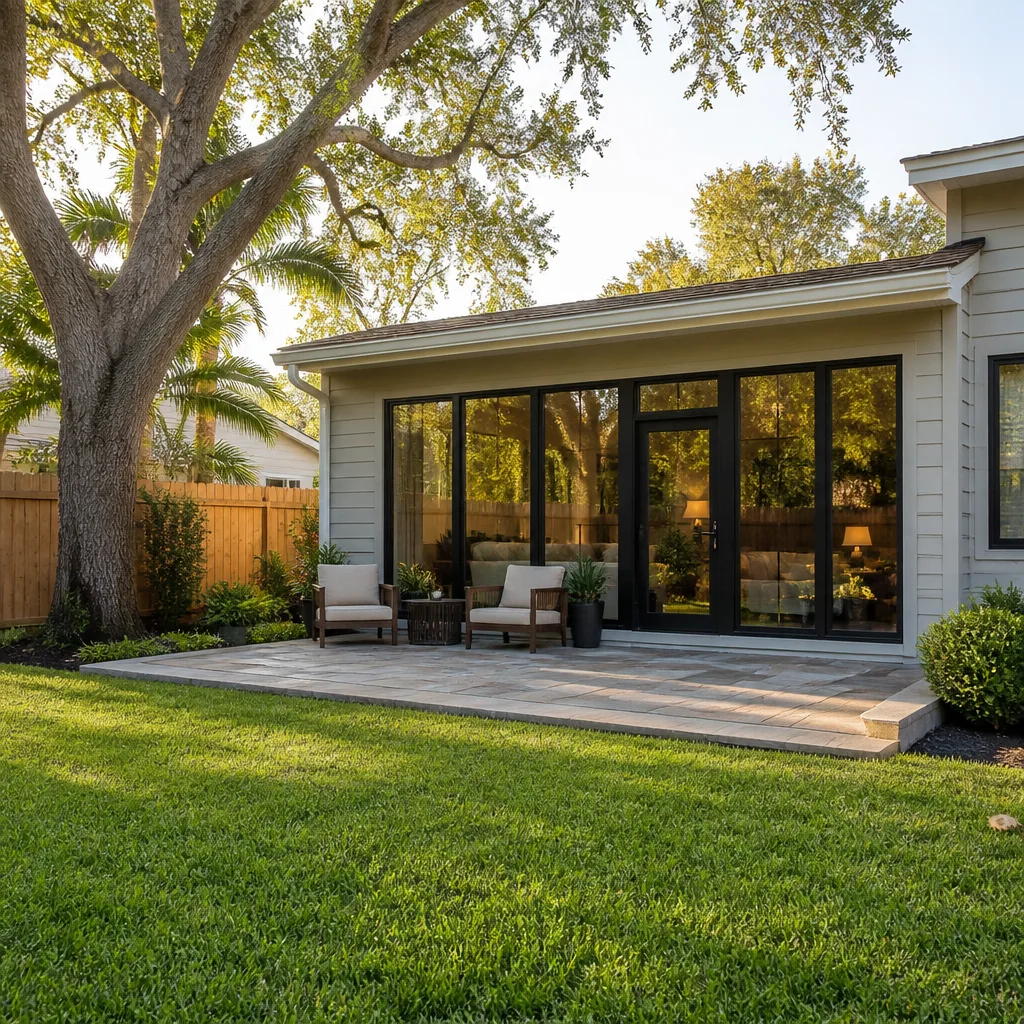
Boxabl’s Casita is built as a 20-foot by 19-foot module – roughly 375 square feet – and arrives on site as a folded, transportable unit that unfolds on a prepared foundation. The key thing to understand for any addition or ADU project in San Diego: a Boxabl unit is not a conventional wood-framed structure, and the interface between your existing module and any new construction needs careful attention. The wall panels are laminated structural panels, not standard 2×4 framing you can tie into with generic hardware. When we run a building addition off the side of a Casita, we have to engineer the connection point so the two structures move independently through San Diego’s dry-warm-cool cycle without cracking at the seam. That’s a compatibility gotcha most general contractors won’t flag until they’re halfway through framing.
For the OEM-versus-aftermarket conversation: Boxabl does not currently sell a factory-built addition module for the Casita. Every expansion is site-built, which means the “part” you’re really buying is the framing package, connection detail, roofing tie-in, and utility rough-in matched to your existing unit. We spec our own assemblies for that. The materials we use – James Hardie siding, CertainTeed or Owens Corning roofing underlayment, Simpson Strong-Tie connectors – are chosen because they hold up in San Diego’s coastal sun and salt air without warping or delaminating. If you’re adding square footage, you’re not buying a Boxabl part. You’re buying a well-built addition that plays nicely with the module you already own.
Styles & brands we work with







Signs Your Boxabl Home Additions & ADU Is Failing
If you’ve already got an addition or ADU tied onto a Boxabl and something feels off, here’s what we see most often in San Diego:
- Cracking at the seam between module and addition. Different materials expand and contract at different rates. A hairline crack that stays under 1/16 inch is usually cosmetic. A crack you can fit a nickel into means the connection detail was done wrong and the buildings are fighting each other.
- Water staining where the addition roof meets the existing Boxabl wall. That transition is the number one leak point on any modular-to-stick-built junction. San Diego’s winter rain isn’t constant, but when it comes, it finds every bad flashing job.
- Doors that suddenly stick or won’t latch. If the addition’s foundation settles faster than the Boxabl module’s pad, the geometry at the threshold shifts. You’ll feel it before you see it.
- Uneven flooring inside the addition. San Diego has expansive clay soils in parts of East County and inconsistent fill closer to the coast. A slab or pier system that wasn’t engineered for the existing soil condition will show dips and crowns within two to three years.
- Window condensation or drywall bubbling near the tie-in wall. That’s moisture getting in somewhere, usually a failed seal at the exterior connection point. In our climate, trapped moisture turns into dry rot faster than people expect, and the fix stops being cheap once the studs are involved.
See the difference
 Before
 After
After Before
 After
After Before
 After
AfterReplacement Cost & What’s Included

For San Diego Boxabl owners, a home addition or in-law unit addition runs $53,100 to $153,400. Here’s what moves the number:
- Square footage. A 400-square-foot bedroom-and-bath addition sits at the lower end. A 1,200-square-foot ADU with a full kitchen, two bedrooms, and a separate entrance pushes toward the top.
- Foundation work. Slab-on-grade is standard and most affordable. Expansive soil or slope conditions requiring piers, retaining walls, or engineered fill add $8,000 to $40,000 quickly.
- Utility runs. Tying into existing sewer, water, and electrical is straightforward if the Boxabl’s service panel and lines are close. A 100-foot sewer lateral through your backyard changes the budget, not the scope.
- Finish level. Builder-grade flooring, stock cabinets from KraftMaid or the equivalent, and modest lighting puts you on the low end. Cambria countertops, custom tile, and a mini-split HVAC system move you up. We’ll spell out exactly where the money goes before anything gets signed.
Every addition we build includes a written price before work starts and the 365-Day Done Right Promise. If something fails inside that year because of our workmanship, we come back and fix it at no charge. That’s in writing, on every project, no exceptions.
DIY or Call Us?
Tell me what you need, I’ll tell you what it costs, and we’ll go from there. That’s how Trevor Nash runs a first meeting, and it sums up the honest answer here. You can handle a few things yourself: clearing the site, deciding on a rough layout, collecting finish ideas, maybe even running a tape measure to confirm the existing Boxabl’s dimensions. None of that requires a permit or a saw.
What you should not do yourself is frame an addition. The connection point where new walls meet a Boxabl module involves structural loading, waterproofing details, and code requirements specific to modular construction in San Diego County. Get that wrong and you’re looking at water intrusion, failed inspections, and a repair bill that exceeds the cost of having done it right the first time. We carry liability insurance, pull all permits, and our crew has built enough additions across San Diego – from Chula Vista flat lots to hillside pads in La Mesa – that the inspection process is routine for us. Call (619) 604-9624 and we’ll walk the property, take measurements, and hand you a written number before anyone swings a hammer.
FAQs

A properly engineered and built addition lasts 50 years or more; the connection detail between the addition and the Boxabl module is the component that typically needs attention first, often within 10 to 15 years if the original flashing was inadequate. San Diego’s coastal salt air and intense UV exposure accelerate sealant breakdown, so we use stainless steel fasteners and UV-stable flashing at every tie-in point. Call (619) 604-9624 if you want us to inspect an existing connection – the estimate is free.
Yes, we repair failing connection seams, roof transitions, and foundation settlement issues without tearing down the entire addition. If the framing is still sound, the fix is usually localized: reflash the tie-in, re-anchor the sill plate, or lift and stabilize a settled slab section. If the framing is rotted or the addition was built without permits, replacement is often cheaper than trying to salvage non-compliant work, and we’ll tell you that plainly. Call (619) 604-9624 and we’ll give you an honest assessment.
A 400-to-800-square-foot addition takes 10 to 16 weeks from permit submittal to final inspection. A full 1,200-square-foot ADU with a separate entrance, kitchen, and bath runs 4 to 6 months. The permitting timeline at San Diego’s Development Services Department is the biggest variable – plan check can take 3 to 8 weeks depending on complexity and current backlog. Call (619) 604-9624 for a realistic timeline on your specific project, based on our experience with the current permitting climate.
We stock common framing hardware, flashing, and fasteners for Boxabl connection work on our trucks, because those are the parts that fail and need replacement during a repair. Full addition projects are ordered from trade brands we trust: KraftMaid and Wellborn for cabinetry, Cambria and Silestone for countertops, James Hardie for siding, and Simpson Strong-Tie for structural hardware. That means the materials behind our 365-Day Done Right Promise are as solid as the promise itself. Call (619) 604-9624 to talk about your project, and we’ll tell you what’s in stock and what gets ordered before the job starts.
Written by Trevor Nash, Owner, Penhallow Remodeling San Diego at Penhallow Remodeling San Diego, serving San Diego and nearby areas.


